What you'll learn
About the Course
The Diploma in Fire and Safety is a comprehensive, 1-year professional program divided into two semesters. It is designed to equip students with the essential knowledge, technical skills, and practical training needed to prevent, manage, and respond to fire hazards and occupational safety risks.
The program bridges the gap between engineering concepts and field operations. Students learn to implement risk-control measures, design emergency evacuation plans, use specialized firefighting equipment, and maintain high standards of safety across various high-risk environments like construction sites, manufacturing plants, and corporate spaces.
Total Number of Lectures Required
While exact scheduling depends heavily on your specific institution's academic calendar and regulatory board, standard diploma programs calculate requirements based on a credit/hour framework rather than just a fixed number of lectures.
For a standard 1-year curriculum of this caliber, the breakdown typically looks like this:
1. Theory Lectures
- Per Subject Requirement: A standard technical theory subject requires roughly 45 to 60 hours of classroom contact time to fully cover the syllabus.
- Total Theory Hours: With 4 core theory subjects per semester (8 total across the year), you can expect 360 to 480 hours of theoretical lectures.
- Lecture Count: If each lecture session is 1 hour long, this translates to 360 to 480 lectures globally over the academic year.
2. Practical & Field Drills
- Safety training requires heavy fieldwork. Industry-standard practicals and drill modules usually demand a minimum of 60 to 100 hours of hands-on field training per semester.
- This adds roughly 120 to 200 hours of field sessions across the entire program.
Summary Estimate
- Total Estimated Hours: ~500 to 680 Hours (Theory + Practical combined)
- Weekly Pace: If scheduled over a standard 30-week academic year (15 weeks per semester), students generally attend 15 to 20 hours of lectures and practicals per week.
Show More
Course Syllabus
Course Syllabus Breakdown
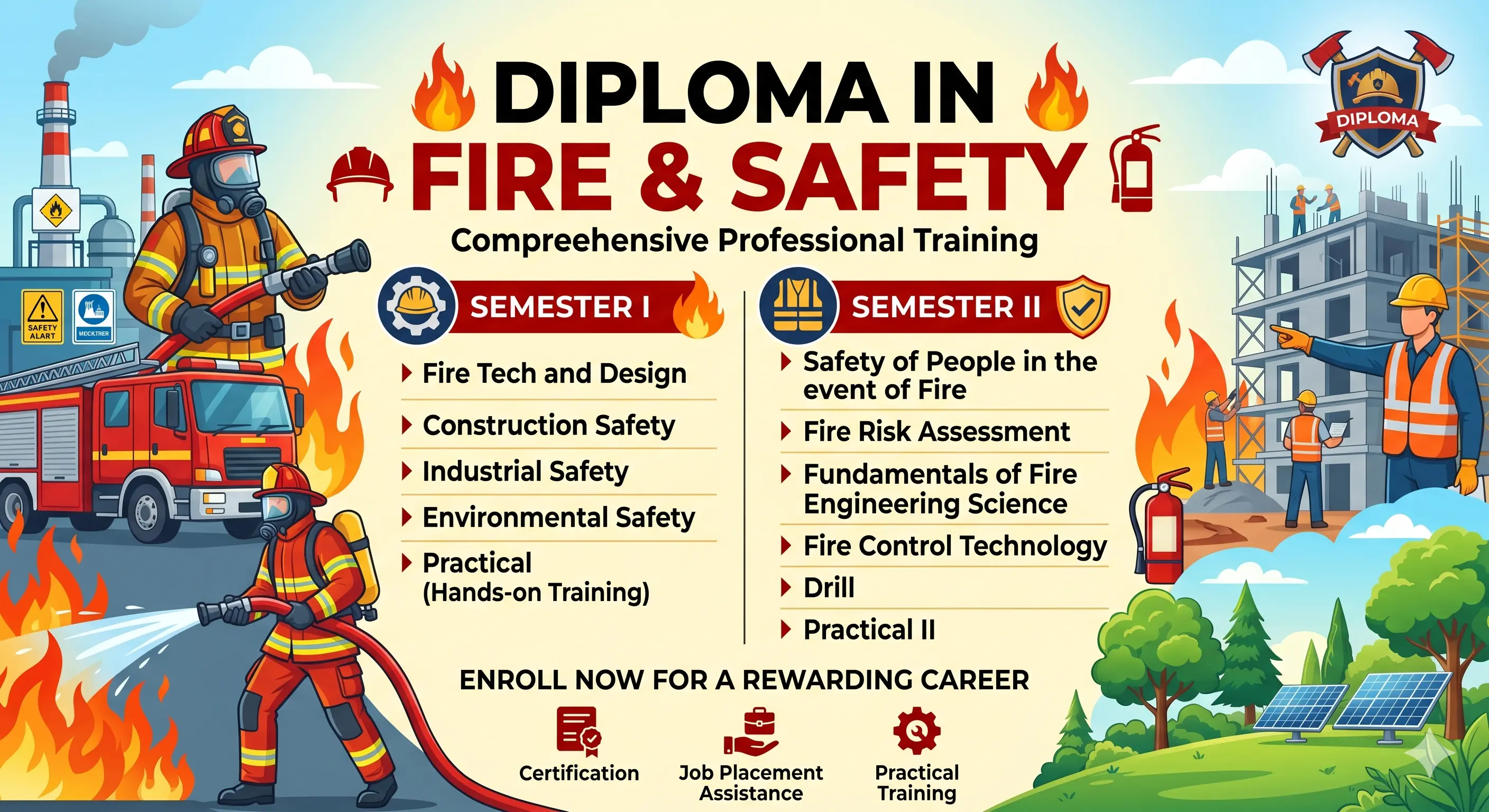
Your specific curriculum offers an excellent, well-balanced approach divided neatly into core foundational safety (Semester I) and specialized fire engineering & disaster response (Semester II):
Semester I: Core Safety & Hazard Foundations
- Fire Tech and Design: Fundamentals of how fire behaves, the science of combustion, and how modern architecture integrates fire prevention designs (like fire walls, exits, and fire-resistant materials).
- Construction Safety: Focused on hazard identification and safety compliance on construction sites (e.g., scaffolding safety, working at heights, heavy equipment management).
- Industrial Safety: Principles of preventing accidents in factories and plants. Covers machine guarding, chemical handling, and workplace ergonomics.
- Environmental Safety: Managing environmental hazards, pollution control, hazardous waste disposal, and adhering to environmental laws.
- Practical Work: Hands-on exposure to primary safety gear, hazard-mapping exercises, and foundational safety inspections.
Semester II: Advanced Fire Engineering & Emergency Response
- Safety of People in the Event of a Fire: Human behavior during emergencies, crowd control, designing foolproof evacuation routes, and emergency lighting systems.
- Fire Risk Assessment: Methodologies for identifying potential fire hazards in a building, analyzing vulnerabilities, and calculating safety scores to prevent disasters before they happen.
- Fundamentals of Fire Engineering Science: The core physics and chemistry of fire, thermodynamics, and the behavior of fluids and gasses under thermal stress.
- Fire Control Technology: Deep dive into active and passive fire suppression systems, including automatic sprinklers, fire hydrants, specialized chemical extinguishers, and alarms.
- Fire Drill: High-intensity field training simulating real-world emergencies, focusing on speed, coordination, and command structures during an evacuation.
- Practical I (Advanced): Live fire-extinguishing practice, handling heavy hoses, operating fire pumps, and administering critical first aid/rescue maneuvers.

 Bestseller